

Maker's Red Box - Cultivating Future Skills through Creative Pedagogy
What is Maker's Red Box?
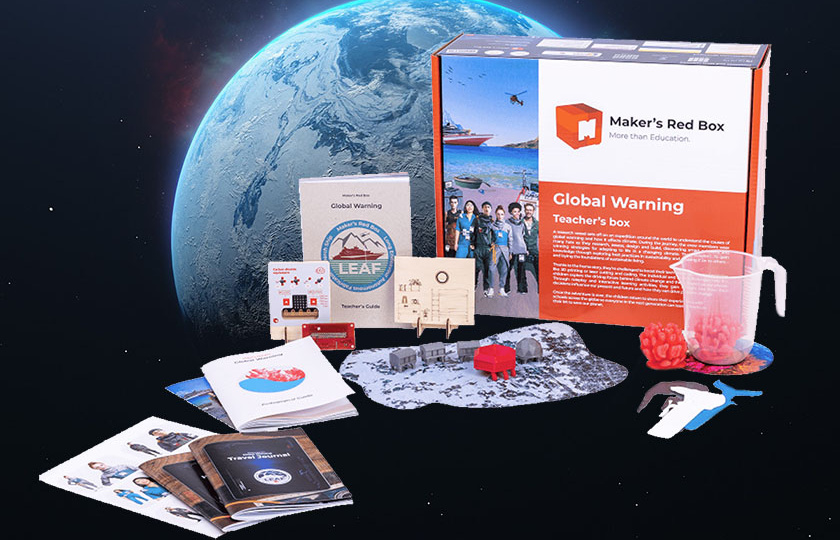
Maker's Red Box develops comprehensive course materials for children aged 11-17 using a creative pedagogy approach that combines technical skill-building with the development of crucial soft skills. Unlike traditional STEM kits that often follow prescriptive, one-size-fits-all approaches, Maker's Red Box employs a constructivist, problem-based framework rooted in maker education principles.
The methodology guides students through extended project-based learning experiences where they develop digital skills alongside teamwork, communication, self-confidence, data literacy, and information management capabilities. Each MRB contains a Teacher's Guide with detailed lesson plans, teaching materials, demonstration tools, and access to an online platform with supporting digital resources.
The Pedagogical Framework
The educational approach of MRB is grounded in epochal, constructivist, problem-based pedagogy. Each course uses storytelling and role-play to challenge children to find solutions to real-world problems, transforming students into astronauts, eco-engineers, or superheroes. This narrative framing provides intrinsic motivation and makes complex skill acquisition feel purposeful and engaging.
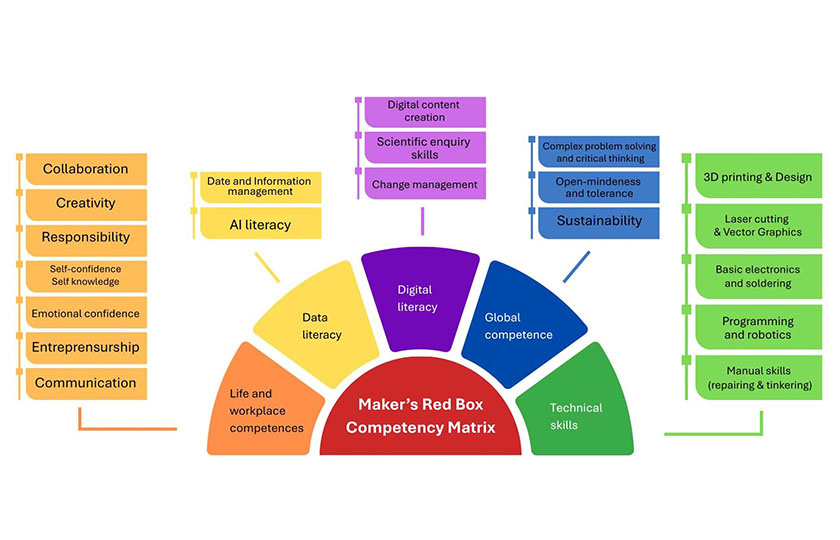
Unlike traditional educational resources, MRB employs a competence matrix that encompasses:
Technical Skills: 3D printing and design, laser cutting and vector graphics, programming and robotics, basic electronics and soldering, and manual crafting skills.
Digital Literacy: Digital content creation, scientific enquiry skills, and change management.
Data Literacy: Data and information management and AI literacy.
Global Competence: Complex problem-solving and critical thinking, open-mindedness and tolerance, and sustainability.
Life and Workplace Competencies: Collaboration, creativity, responsibility, self-confidence, emotional competence, entrepreneurship, and communication.
This comprehensive framework enables teachers to track student progress through personal, ipsative assessment, making it valuable for identifying individual strengths and providing meaningful career guidance.
Course Materials and Requirements
Maker's Red Box offers several thematic course packages, each containing a comprehensive 16-session programme:
The City of the Future: Students tackle urban design and development, finding future-oriented solutions to current city problems while learning to use 3D printers, sensors, and microcontrollers.
Green Engineers: Teams undertake the recolonisation of Mars, using engineering skills and scientific approaches to overcome challenges.
Superheroes – Digital Storytelling: Children become superheroes in their own universe, engaging in creative writing and problem-solving while creating working objects like personalised night lamps.
Global Warning: Students embark on a research voyage to understand climate change impacts worldwide, learning sustainability practices and developing technical skills.
Each course requires specific equipment, with “City of the Future” needing 2-4 3D printers, 12 micro:bits, 3-4 soldering stations, and 12 notebooks for an optimal group of 12 children. Walsh's experience suggests these requirements can be adapted based on available resources and student age.
Considerations for Implementation
Time Requirements: Double sessions (90+ minutes) work best for the activities, which may require adjustments to typical class schedules.
Technical Support: While any teacher can facilitate the programme regardless of subject specialisation, basic digital skills and openness to technology are necessary. A technical assistant can be helpful for troubleshooting.
Age Appropriateness: Walsh found the materials adaptable for children from age 11 upwards, suitable for the final two years of primary school (5th and 6th class) and secondary schools.
Group Size: An ideal group size is 12 students (maximum 16) managed by at least one teacher, with collaboration rather than competition emphasised.
Benefits for Irish Schools
The MRB approach offers several advantages for Irish educational settings:
Cross-curricular Integration: The framework aligns with multiple areas of the Irish curriculum and can be implemented as in-school activities, after-school programmes, or summer camps.
Inclusive by Design: The materials accommodate students of varying competencies and backgrounds.
Teacher Support: The comprehensive Teacher's Guide provides detailed plans and resources, allowing educators with basic digital skills to confidently facilitate the programme.
Skill Development Measurement: The included assessment tool helps track individual student progress, making it valuable for identifying strengths and providing career guidance.
Student Engagement: High student engagement with the programme, particularly with the micro:bit programming and 3D making elements.
The Future of Maker Education in Ireland
As Irish schools continue to integrate technology and develop future-focused curricula, approaches like Maker's Red Box offer a structured yet flexible framework for developing both technical and soft skills. The methodology has been tested with over 20,000 children and 800 teachers internationally, with implementations in over 20 countries.
By employing a creative pedagogy approach that emphasises problem-solving, collaboration, and hands-on making, Irish educators can help students develop the complex competencies needed for future success while maintaining engagement through purposeful, playful learning.
The programme brings the engineering design process and design thinking theories together in a way that engage students from diverse backgrounds in meaningful, creative learning.
- What is Maker's Red Box?
- Course Materials and Requirements
- Benefits for Irish Schools